Why spraying the ants on your counter makes the problem worse
The ants that come back after a kitchen spray are usually not the same ants. They are the rest of the colony, relocated.
September 1, 2026 · 4 min read
Almost everybody tries this first, and it is a completely reasonable thing to try. There is a line of ants marching along the counter, there is a can under the sink, you spray the line, and the line stops. Job done, apparently.
Then a week or two later there are ants in the bathroom. And behind the washing machine. And along a skirting board in a bedroom nobody eats in.
The bit the can does not tell you
Ants live in colonies, and the ones you can see are a tiny working minority. The rest, including the part of the colony that actually produces more ants, is somewhere you cannot see: in a wall void, under a slab, beneath the front step, out in the yard.
Most consumer sprays are what the trade calls repellents. Ants can detect them. When an ant walks into a repellent it dies, and the colony registers that a section of its territory has become lethal. A colony under pressure does something specific about that. It splits. Part of it relocates and starts over somewhere else in the structure, which is why one problem in the kitchen becomes three problems in rooms you had not thought about.
So the spray worked, in the narrow sense that the ants you sprayed are dead. It just converted a contained problem into a distributed one.
What a non-repellent does instead
A non-repellent is undetectable to an ant. She walks straight through it, carries on foraging, goes home, and shares food the way ants do. The product travels with her into the nest and reaches the part of the colony you were never going to get to with a can. The colony goes, rather than scattering.
Baits work on the same logic from the other direction. The ant is not being killed on contact at all. She is being used as transport.
This is why a professional treatment can look underwhelming for the first few days. If ants are still trailing on day two, that is often the product doing precisely what it is supposed to do. Instant is the wrong measure here.
What you can do that genuinely helps
- Leave the trail alone until it has been treated, because the trail tells a technician where the nest is
- Do not spray a repellent over a bait or a non-repellent, which undoes both
- Wipe counters and store open food, so the bait is the most attractive thing available
- Note where the trail enters the room, not just where it ends up
Indoors or outdoors: two different jobs
There is one question worth answering before anybody treats anything, and it is whether the colony is living inside the structure or foraging in from the yard. Both look identical on your counter and they are not the same job.
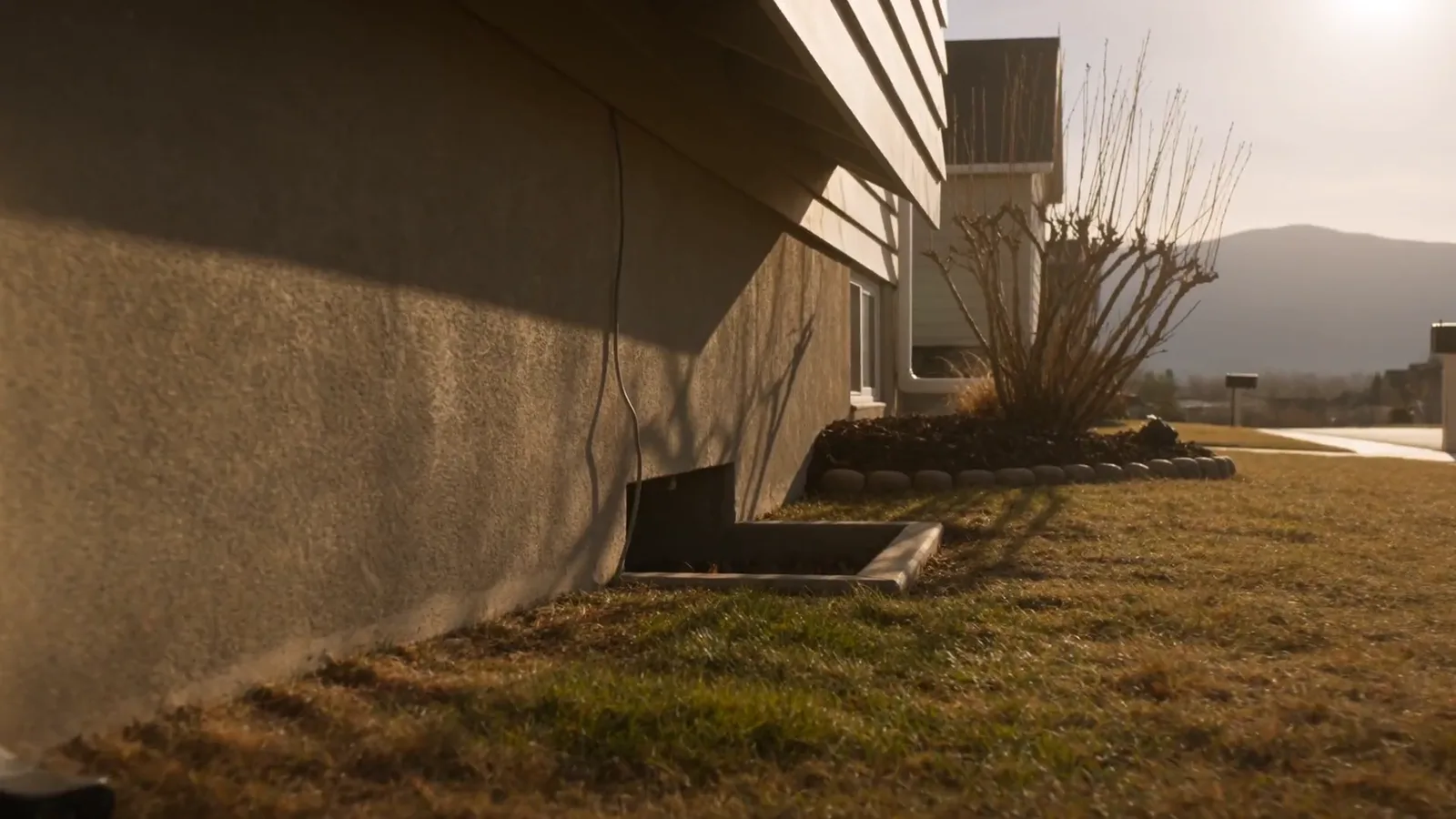
A foraging colony is outside, usually within a few metres of the house, and the ants are commuting. You tend to see a consistent trail along the same route at the same times, and it will lead you to an entry point: a gap at a door threshold, a utility penetration, a crack where the slab meets the wall. Treat the exterior and the entry point and the traffic stops.
A colony that has established inside a wall void behaves differently. The trails are shorter, they appear in more than one room, and they do not obviously come from anywhere outdoors. That one needs the non-repellent to be carried inward from where the ants actually are, which means finding them first rather than treating the perimeter and hoping.
This is the sort of thing that gets sorted out in about ten minutes on site and is nearly impossible to guess over the phone. It is also why a free consultation before any quote is worth taking.
And while we are here, earwigs
Earwigs get lumped in with ants because they turn up in the same complaints, but they are an outdoor problem that wanders indoors. They live in mulch, in damp soil, and in decayed wood. If you have earwigs inside, the reason is almost always sitting against the outside of your house: a mulch bed banked up against the wall, a woodpile, a damp shaded strip that never dries out.
Treating the yard and the garden is what fixes earwigs. Treating the bathroom where you found one is chasing a symptom, and it is why the same house has the same problem the following spring.
The short version
If ants keep coming back in new places, stop reaching for the can. What looks like a failed treatment is usually a successful one working against you. Nature's Way uses baits and non-repellents for exactly this reason, and a free consultation is a cheaper way to find the nest than another fortnight of guessing.
Nature's Way Pest Solutions — (801) 513-4106
Call (801) 513-4106More articles
How to tell a black widow from every other spider in your garage
The identification takes about four seconds once you know what you are looking at. What comes after it is the part most people get wrong.
Next spring's infestation is being decided right now
By the time you see anything in April, the decision that produced it was made months earlier.